Literature review
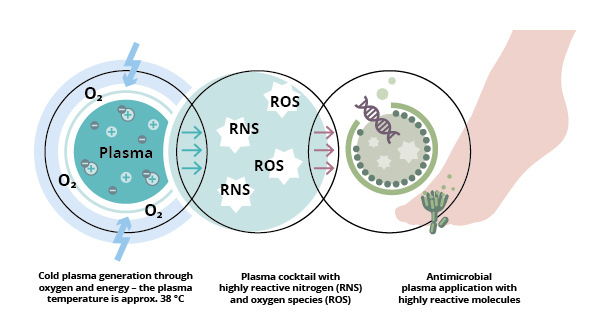
(A) Antifungal effects of cold plasma
[1] Gnat, S., Łagowski, D., Dyląg, M. et al. Cold atmospheric pressure plasma (CAPP) as a new alternative treatment method for onychomycosis caused by Trichophyton verrucosum: in vitro studies. Infection 49, 1233–1240 (2021). https://doi.org/10.1007/s15010-021-01691-w
[2] S. R. Lipner, G. Friedman, R. K. Scher, Pilot study to evaluate a plasma device for the treatment of onychomycosis, Clinical and Experimental Dermatology, Volume 42, Issue 3, 1 April 2017, Pages 295–298, https://doi.org/10.1111/ced.12973
[3] Xiong, Z., Roe, J., Grammer, T.C. and Graves, D.B. (2016), Plasma Treatment of Onychomycosis. Plasma Process. Polym., 13: 588-597. https://doi.org/10.1002/ppap.201600010
(B) Hormesis effects and regenerative effects of cold plasma
[4] Schmidt A, Dietrich S, Steuer A, Weltmann KD, von Woedtke T, Masur K, Wende K. Non-thermal plasma activates human keratinocytes by stimulation of antioxidant and phase II pathways. J Biol Chem. 2015 Mar 13;290(11):6731-50. https://doi.org/10.1074/jbc.M114.603555
[5] von Woedtke, T., Schmidt, A., Bekeschus, S., Wende, K., & Weltmann, K.-D. (2019). Plasma Medicine: A Field of Applied Redox Biology. In Vivo, 33(4), 1011–1026. https://doi.org/10.21873/invivo.11570
[6] Ahn, G. R., Park, H. J., Koh, Y. G., Shin, S. H., Kim, Y. J., Song, M. G., Lee, J. O., Hong, H. K., Lee, K. B., & Kim, B. J. (2022). Low-intensity cold atmospheric plasma reduces wrinkles on photoaged skin through hormetic induction of extracellular matrix protein expression in dermal fibroblasts. Lasers in Surgery and Medicine, 54(7), 978–993. https://doi.org/10.1002/lsm.23559
[7] Schmidt, A., Bekeschus, S., Wende, K., Vollmar, B., & von Woedtke, T. (2017). A cold plasma jet accelerates wound healing in a murine model of full-thickness skin wounds. Experimental Dermatology, 26(2), 156–162. https://doi.org/10.1111/exd.13156
[8] Jung, J. M., Yoon, H. K., Won, C. H., Seo, Y. K., & Park, Y. W. (2021). Cold Plasma Treatment Promotes Full-thickness Healing of Skin Wounds in Murine Models. Journal of Experimental & Clinical Medicine, 13(2), 456–467. https://doi.org/10.1177/15347346211002144
[9] Tan, F., Wang, Y., Zhang, S., Shui, R., & Chen, J. (2022). Plasma Dermatology: Skin Therapy Using Cold Atmospheric Plasma. Frontiers in Oncology, 12, 918484. https://doi.org/10.3389/fonc.2022.918484
[10] Busco, G., Robert, E., Chettouh-Hammas, N., Pouvesle, J.-M., & Grillon, C. (2020). The emerging potential of cold atmospheric plasma in skin biology. Free Radical Biology and Medicine, 161, 290–304. https://doi.org/10.1016/j.freeradbiomed.2020.10.004
[11] Choi, J. H., Song, Y. S., Song, K., Lee, H. J., Hong, J. W., & Kim, G. C. (2016). Skin renewal activity of non-thermal plasma through the activation of β-catenin in keratinocytes. Scientific Reports, 6, 27376. https://doi.org/10.1038/srep27376
[12] Kisch, T., Schleusser, S., Limpert, R., Seuser, A., Mailänder, P., Kraemer, R., & Arnemann, J. (2016). Initiation of microcirculation by cold atmospheric plasma. Wound Repair and Regeneration, 24(6), 1023–1030. https://doi.org/10.1111/wrr.12479

 Your basket is empty.